The First Thing We Should Have Done Before Planning a Build

Illustrative image generated to represent part of the planning process.
The first thing we did after deciding to build was not research permits.
It was a whiteboard.
We were excited.
Really excited.
We started sketching ideas for what we wanted to build — the size, the layout, the style, the rooms, the features.
For a few hours it felt like everything was wide open.
At the time, we assumed the hardest part would be figuring out what we wanted to build.
Possibility has a way of doing that.
When you’re standing at the beginning of something big, it’s easy to believe the only limits are your imagination.
But eventually reality enters the picture.
Because once you start talking about building on land, there’s another layer that sits underneath all the excitement:
Permits.
Township regulations.
Subdivision requirements.
And we quickly realized something important.
The first thing we should have done wasn’t drawing on the whiteboard.
It was understanding what was actually allowed.
That realization sent us down a path of researching permits, township rules, and subdivision requirements — things we hadn’t thought much about before.
Dreaming is easy when the whiteboard is blank.
Planning starts when you learn what the land actually allows.
What Those Rules Can Look Like
Every piece of land exists inside a framework of rules.
Those rules can change depending on things like:
the type of land
zoning classifications
how the property is divided
local permitting requirements
And while the specifics vary depending on where you live, here are a couple of examples of the kinds of things that often come into play when you start researching permits and township regulations.
Setback Requirements
One of the first things people run into are setback requirements.
Most townships have rules about how far a structure has to sit from things like property lines, roads, or neighboring buildings.
That means even if a piece of land looks wide open, there may only be certain areas where a house or structure is actually allowed to go.
Sometimes those boundaries are generous.
Sometimes they’re tighter than you’d expect.
Either way, they’re something you have to understand before you start designing anything.
Use Restrictions
Another common layer involves what the land is zoned for and how it can be used.
Some areas are very flexible, while others have rules about things like:
the type of structures allowed
minimum building sizes
accessory buildings
how many dwellings can exist on a property
None of these rules are inherently bad — they’re usually there to maintain consistency and safety within a township.
But they do shape what’s possible, and sometimes they require adjusting the original vision.
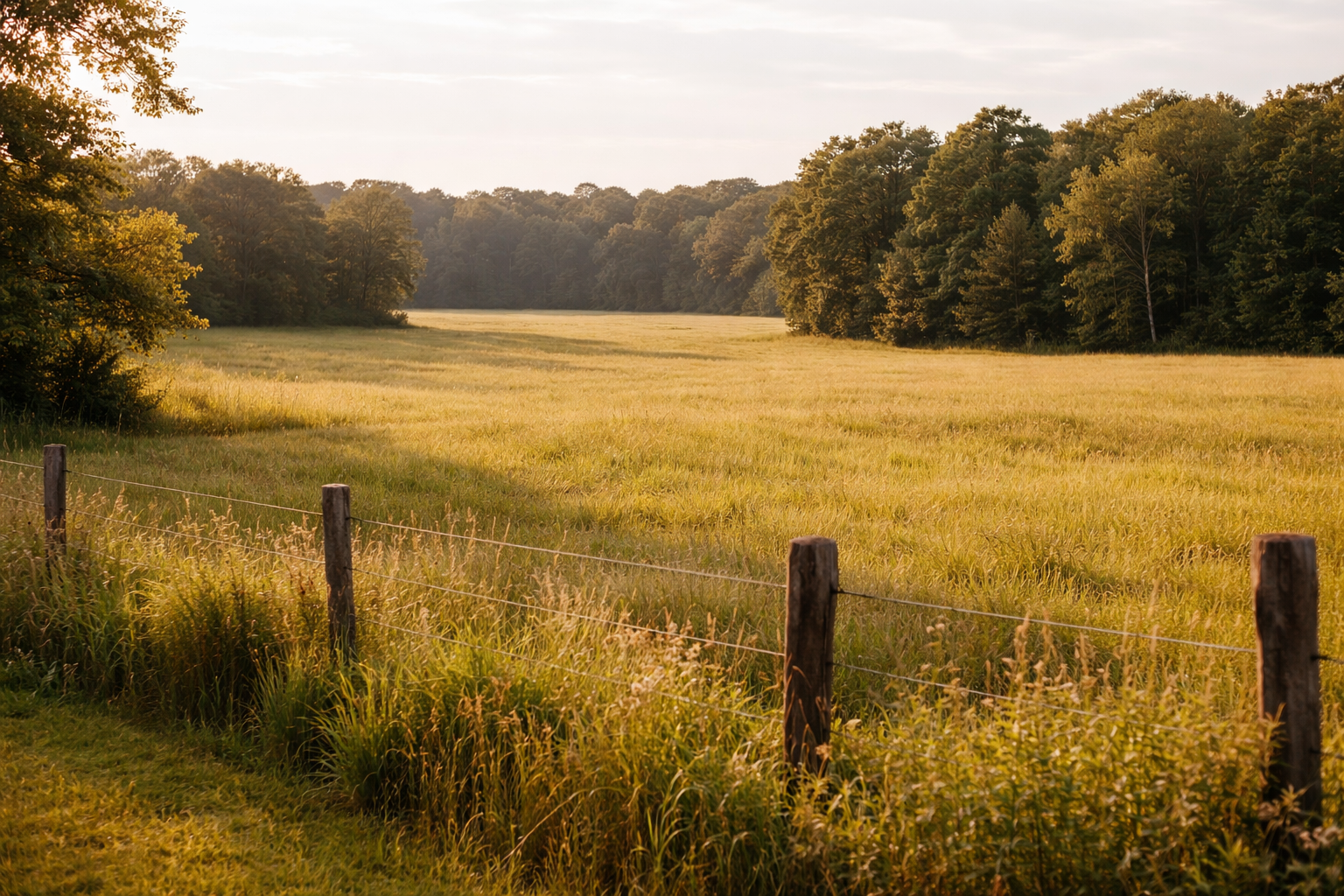
Illustrative image representing raw land before construction begins.
Subdivision
That’s the point where we realized something important.
The whiteboard phase is exciting because everything feels possible.
But the permitting phase is where the real planning begins.
Because once you understand the rules that apply to the land, the dream starts to take a more realistic shape.
In our case, the land sits on family property.
Which meant we quickly learned something we hadn’t thought much about before: subdivision.
Even though the land exists and has always been part of the farm, creating a separate build site requires its own process.
Surveying.
Approvals.
Paperwork.
It’s not complicated once you understand it — but it’s not something you can skip either.
It’s one of those steps that happens quietly in the background before anything visible begins.
The Reality Check
This was the first moment where the project started to feel real.
Because once you start talking to the township, you’re no longer just imagining a build.
You’re working within actual regulations, timelines, and requirements.
It forces you to slow down and understand what the process really looks like.
And honestly, that’s probably a good thing.
One thing this process has made very clear is how helpful it is to understand the rules attached to a piece of land as early as possible.
If you’re thinking about buying land — or even if land is being offered to you — it’s worth taking some time to research the local regulations before making any big decisions.
Not because it changes the value of the opportunity, but because it helps you understand what’s actually possible there.
Every piece of land comes with its own framework of rules.
Knowing that framework ahead of time can help shape expectations, timelines, and plans from the start.
For us, the opportunity to build on family land is something we’re incredibly grateful for.
Learning the rules didn’t change that — it just helped us understand how to move forward more thoughtfully.
What We’ve Learned
If there’s one thing we’ve learned already, it’s this:
The beginning of a build doesn’t look like construction.
It looks like research.
Phone calls.
Emails.
Understanding the rules.
It’s not the part people picture when they imagine building something on land, but it’s the part that makes everything else possible.
Right now we’re still in that phase.
Learning.
Asking questions.
Understanding what has to happen before the first piece of equipment ever shows up.
It’s not the most exciting part of the journey.
But it’s the part where the dream starts turning into a real plan.
And that’s a pretty important place to begin.
Because once you start understanding the rules, a lot of other questions begin to surface.
Things like utilities, wells, septic systems, and how the land itself will support what you’re trying to build.
Those are the kinds of things we’re starting to work through next.
